ORIGINAL ARTICLE
Does an ERAS-based perioperative protocol improve functional outcomes and length of stay after primary total hip arthroplasty in patients over 65?
1
Department of Orthopedicss and Traumatology of University Hospital in Krakow, Poland
2
International Evidence-Based Anatomy Working Group, Krakow, Poland
3
Doctoral School of Medical Sciences and Health Sciences, Jagiellonian University Medical College, Krakow, Poland
4
Department of Orthopedics and Traumatology, Faculty of Medicine, Jagiellonian University Medical College, Krakow, Poland
Submission date: 2026-05-16
Final revision date: 2026-07-31
Acceptance date: 2026-08-06
Online publication date: 2026-11-24
Corresponding author
Henryk Liszka
Trauma and Orthopaedics Clinical Department, University Hospital, Jagiellonian University Medical College, 30-688 Krakow, Poland
KEYWORDS
functional outcomeelderly patientship osteoarthritisenhanced recovery after surgeryprimary hip arthroplasty
TOPICS
ABSTRACT
Introduction:
Total hip arthroplasty is the treatment of choice for advanced hip osteoarthritis, particularly in older adults with pain and marked functional limitation. Enhanced Recovery After Surgery (ERAS) protocols have been introduced to optimize perioperative care and improve postoperative recovery.
Aim:
To evaluate whether an authors’ perioperative protocol based on ERAS principles improves outcomes compared with standard care in patients over 65 years of age undergoing primary total hip arthroplasty.
Material and methods:
A total of 362 patients qualified for primary hip arthroplasty were included. The standard treatment group (ST) comprised 121 patients, whereas the authors’ protocol group (AU) included 241 patients. Outcomes were assessed using the Harris Hip Score (HHS), WOMAC, Physical Activity Scale for the Elderly (PASE), Numeric Rating Scale (NRS), length of hospital stay, and the number of intra- and postoperative complications. Measurements were performed preoperatively and 12 months postoperatively, except for complications, which were assessed up to 30 days after surgery.
Results and conclusions:
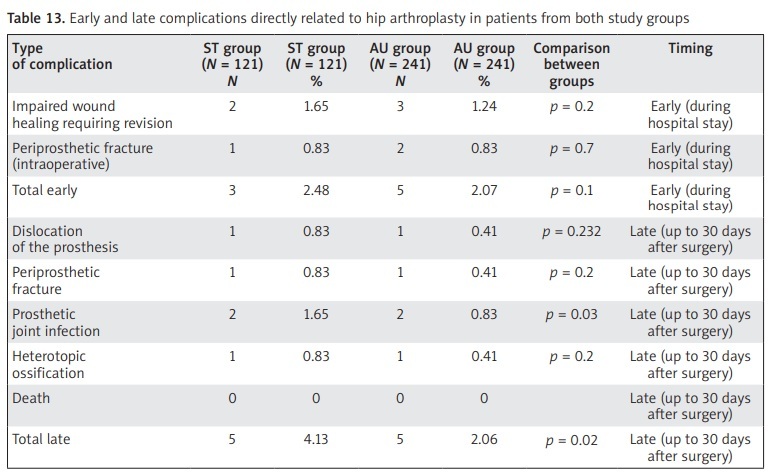
Both groups showed significant postoperative improvement in HHS, WOMAC, PASE, and NRS scores. However, significantly better functional outcomes were observed in the AU group, reflected by higher HHS and lower WOMAC scores. Hospital stay was also significantly shorter in the AU group. No significant intergroup differences were found for physical activity, pain intensity, or complication rates. The authors’ ERAS-based protocol was more effective than standard care in improving functional recovery and reducing length of stay after primary total hip arthroplasty in patients over 65 years of age.
REFERENCES (33)
1.
Gupta S, Hawker GA, Laporte A, Croxford R, Coyte PC. The economic burden of disabling hip and knee osteoarthritis from the perspective of individuals living with this condition. Rheumatology. 2005; 44: 1531-1537.
2.
Learmonth ID, Young C, Rorabeck C. The operation of the century: total hip replacement. Lancet. 2007; 370: 1508-1519.
3.
Evans JT, Evans JP, Walker RW, Blom AW, Whitehouse MR, Sayers A. How long does a hip replacement last? A systematic review and meta-analysis of case series and national registry reports with more than 15 years of follow-up. Lancet. 2019; 393: 647-654.
4.
Hwang SK. Experience of complications of hip arthroplasty. Hip Pelvis. 2014; 26: 207-213.
5.
Ibrahim MS, Twaij H, Giebaly DE, Nizam I, Haddad FS. Enhanced recovery in total hip replacement. Bone Joint J. 2013; 95-B: 1587-1594.
6.
Soffin EM, YaDeau JT. Enhanced recovery after surgery for primary hip and knee arthroplasty: a review of the evidence. Br J Anaesth. 2016; 117(S3): iii62-iii72.
7.
Wainwright TW, Gill M, McDonald DA, Middleton RG, Reed M, Sahota O, Yates P, Ljungqvist O. Consensus statement for perioperative care in total hip replacement and total knee replacement surgery: Enhanced Recovery After Surgery Society recommendations. Acta Orthop. 2020; 91: 3-19.
8.
Guerra ML, Singh PJ, Taylor NF. Early mobilization of patients who have had a hip or knee joint replacement reduces length of stay in hospital: a systematic review. Clin Rehabil. 2015; 29: 844-854.
9.
Sprowson A, McNamara I, Manktelow A. Enhanced recovery pathway in hip and knee arthroplasty: “fast track” rehabilitation. Orthop Trauma. 2013; 27: 296-302.
10.
Bondy LR, Sims N, Schroeder DR, Offord KP, Narr BJ. The effect of anesthetic patient education on preoperative patient anxiety. Reg Anesth Pain Med. 1999; 24: 158-164.
11.
Yoon RS, Nellans KW, Geller JA, Kim AD, Jacobs MR, Macaulay W. Patient education before hip or knee arthroplasty lowers length of stay. J Arthroplasty. 2010; 25: 547-551.
12.
Kehlet H. Fast-track hip and knee arthroplasty. Lancet. 2013; 381(9878): 1600-1602.
13.
Barrett M, Prasad A, Boyce L, Dawson-Bowling S, Achan P, Millington S, Hanna SA. Total hip arthroplasty outcomes in morbidly obese patients: a systematic review. EFORT Open Rev. 2018; 3: 507-512.
14.
Muñoz M, Gómez-Ramírez S, Cuenca J, García-Erce JA, Iglesias-Aparicio D, Haman-Alcober S, Ariza D, Naveira E. Very-short-term perioperative intravenous iron administration and postoperative outcome in major orthopedic surgery: a pooled analysis of observational data from 2547 patients. Transfusion. 2014; 54: 289-299.
15.
Spahn DR. Anaemia and patient blood management in hip and knee surgery: a systematic review of the literature. Anesthesiology. 2010; 113: 482-495.
16.
Memtsoudis SG, Sun X, Chiu YL, Stundner O, Liu SS, Banerjee S, Mazumdar M, Sharrock NE. Perioperative comparative effectiveness of anesthetic technique in orthopedic patients. Anesthesiology. 2013; 118: 1046-1058.
17.
Johnson RL, Kopp SL, Burkle CM, Duncan CM, Jacob AK, Erwin PJ, Murad MH, Mantilla CB. Neuraxial vs general anaesthesia for total hip and total knee arthroplasty: a systematic review of comparative-effectiveness research. Br J Anaesth. 2016; 116: 163-176.
18.
Harris WH. Traumatic arthritis of the hip after dislocation and acetabular fractures: treatment by mold arthroplasty. An end-result study using a new method of result evaluation. J Bone Joint Surg Am. 1969; 51: 737-755.
19.
Söderman P, Malchau H. Is the Harris Hip Score system useful to study the outcome of total hip replacement? Clin Orthop Relat Res. 2001; 384: 189-197.
20.
McConnell S, Kolopack P, Davis AM. The Western Ontario and McMaster Universities Osteoarthritis Index: a review of its utility and measurement properties. Arthritis Rheum. 2001; 45: 453-461.
21.
Bellamy N, Buchanan WW, Goldsmith CH, Campbell J, Sitt LW. Validation study of WOMAC: a health status instrument for measuring clinically important patient-relevant outcomes to antirheumatic drug therapy in patients with osteoarthritis of the hip or knee. J Rheumatol. 1988; 15: 1833-1840.
22.
Washburn RA, Smith KW, Jette AM, Janney CA. The Physical Activity Scale for the Elderly: development and evaluation. J Clin Epidemiol. 1993; 46: 153-162.
23.
Washburn RA, McAuley E, Katula J, Mihalko SL, Boileau RA. The Physical Activity Scale for the Elderly: evidence for validity. J Clin Epidemiol. 1999; 52: 643-651.
24.
Hawker GA, Mian S, Kendzerska T, French M. Measures of adult pain: Visual Analog Scale for Pain, Numeric Rating Scale for Pain, McGill Pain Questionnaire, Short-Form McGill Pain Questionnaire, Chronic Pain Grade Scale, Short Form-36 Bodily Pain Scale, and Measure of Intermittent and Constant Osteoarthritis Pain. Arthritis Care Res. 2011; 63: S240-S252.
25.
Ripollés-Melchor J, Abad-Motos A, Díez-Remesal Y, Aseguinolaza-Pagola M, Padin-Barreiro L, Sánchez-Martín R, Logroño-Egea M, Catalá-Bauset JC, García-Orallo S, Bisbe E, Martín N, Suárez-de-la-Rica A, Cuéllar-Martínez AB, Gil-Trujillo S, Estupiñán-Jiménez JC, Villanova-Baraza M, Gil-Lapetra C, Pérez-Sánchez P, Rodríguez-García N, Ramiro-Ruiz A, Farré-Tebar C, Martínez-García A, Arauzo-Pérez P, García-Pérez C, Abad-Gurumeta A, Miñambres-Villar MA, Sánchez-Campos A, Jiménez-López I, Tena- Guerrero JM, Marín-Peña O, Sánchez-Merchante M, Vicente-Gutiérrez U, Cassinello-Ogea MC, Ferrando-Ortolá C, Berges-Gutiérrez H, Fernanz-Antón J, Gómez-Ríos MA, Bordonaba-Bosque D, Ramírez-Rodríguez JM, García-Erce JA, Aldecoa C; Postoperative Outcomes Within Enhanced Recovery After Surgery Protocol in Elective Total Hip and Knee Arthroplasty (POWER2) Study Investigators Group for the Spanish Perioperative Audit and Research Network (REDGERM). Association between use of Enhanced Recovery After Surgery protocol and postoperative complications in total hip and knee arthroplasty in the Postoperative Outcomes Within Enhanced Recovery After Surgery Protocol in Elective Total Hip and Knee Arthroplasty study. JAMA Surg. 2020; 155: e196024.
26.
Larsen K, Hvass K, Hansen TB, Thomsen PB, Søballe K. Effectiveness of accelerated perioperative care and rehabilitation intervention compared to current intervention after hip and knee arthroplasty: a before-after trial of 247 patients with a 3-month follow-up. BMC Musculoskelet Disord. 2008; 9: 59.
27.
den Hartog YM, Mathijssen NM, Vehmeijer SB. Reduced length of hospital stay after the introduction of a rapid recovery protocol for primary THA procedures. Acta Orthop. 2013; 84: 444–447.
28.
Husted H, Jensen CM, Solgaard S, Kehlet H. Reduced length of stay following hip and knee arthroplasty in Denmark 2000–2009: from research to implementation. Arch Orthop Trauma Surg. 2012; 132: 101-104.
29.
Christelis N, Wallace S, Sage CE, Babitu U, Liew S, Dugal J, Nyulasi I, Mutalima N, Tran T, Myles PS. An enhanced recovery after surgery program for hip and knee arthroplasty. Med J Aust. 2015; 202: 363-368.
30.
Gwynne-Jones DP, Martin G, Crane C. Enhanced recovery after surgery for hip and knee replacements. Orthop Nurs. 2017; 36: 203-210.
31.
Nicholson A, Lowe MC, Parker J, Lewis SR, Alderson P, Smith AF. Systematic review and meta-analysis of enhanced recovery programmes in surgical patients. Br J Surg. 2014; 101: 172-188.
32.
Barbieri A, Vanhaecht K, Van Herck P, Sermeus W, Faggiano F, Marchisio S, Panella M. Effects of clinical pathways in joint replacement: a meta-analysis. BMC Med. 2009; 7: 32.
33.
Leiss F, Götz JS, Maderbacher G, Meyer M, Reinhard J, Zeman F, Grifka J, Greimel F. Excellent functional outcome and quality of life after primary cementless total hip arthroplasty using an enhanced recovery setup. J Clin Med. 2021; 10: 621.
| eISSN: | 2300-6722 |
| ISSN: | 1899-1874 |

We process personal data collected when visiting the website. The function of obtaining information about users and their behavior is carried out by voluntarily entered information in forms and saving cookies in end devices. Data, including cookies, are used to provide services, improve the user experience and to analyze the traffic in accordance with the Privacy policy. Data are also collected and processed by Google Analytics tool (more).
You can change cookies settings in your browser. Restricted use of cookies in the browser configuration may affect some functionalities of the website.